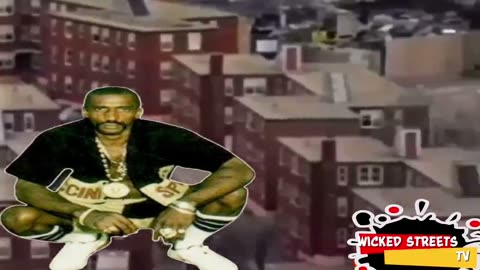
Boston's crack game really kicked off end of 86 when Darryl Whiting touched down in Roxbury's Orchard Park projects. My man pulled up draped in ice so blinding it had the whole city watching. Streets was buzzing that them diamonds he was rocking came from some massive stone he grabbed out in Africa, and that flashy jewelry wasn't just about looking fly. It was sending a message that the game was about to shift. They called him God, a title that carried weight. Not just off his street power, but because of where he came from. He was entrenched in the 5% Nation, that branch off the Nation of Islam, and in that world every man rocks the name Allah, a title that meant something real, especially when you backed it up with action. Whiting wasn't always God though. Back in the days he was just another young stick-up kid from New York doing a six-year bid. But now he was 30, fresh off parole, and he was about to run the whole show, leaving that small-time robber past in the rearview. Boston had no clue what was about to hit them. Whiting landed in Boston right when the cocaine trade was about to blow up. Counselors was already ringing alarm bells about crack use spreading through Dorchester and Roxbury, warning everybody that the streets was about to transform. Boston's first crack spot had already opened up on Columbia Road, but it wasn't until Whiting came through and built his $11 million empire that the city really felt the crack wave crash down hard. Before you knew it, Orchard Park's Bump Road was running 24-7, moving up to $100,000 a day in cocaine, and Whiting was orchestrating the whole operation like a real kingpin. But even with his empire expanding at lightning speed, Whiting stayed in the shadows. Law enforcement was in the dark, with the US Attorney at the time admitting in 1990 that he'd only caught whispers about him. It wasn't until Whiting gave that infamous interview to the Phoenix where he showed off his success and swagger that the feds finally got serious. That interview would eventually push them to go undercover, laying the trap to take down the mysterious figure who had become the center of Boston's crack trade. Whiting became infamous as Boston's first cat to catch a life sentence on drug charges, a dark milestone in the city's history. His come-up and downfall is still the blueprint story of Boston's crack epidemic, packed with legends and raw truths that explain a lot about today's gang culture. Man Terror, a rapper who came up in the Orchard Park projects, was just a shorty when Whiting arrived. He remembers the aura Whiting brought to the block. When God walked through the projects, he says, it was like everything just froze up. People paid attention when Whiting was in the spot, and his presence controlled the whole strip. Whiting's strategy for claiming territory was vicious and calculated. He went after vulnerable women, especially single mothers, to set up shop in their apartments. He either paid them off or scared them into letting him run his business out of their cribs. One of his first targets was Miss Carol, a well-known older woman in the projects who was already familiar with the drug world. Miss Carol was the elder OG lady in the projects, a former resident remembers. Everybody would roll through her crib, smoke a little weed. When Whiting came in through her, it wasn't like they conquered the project overnight. They just started a small operation. That small operation exploded into an empire quick. Whiting made it crystal clear that anybody who didn't buy his crack wouldn't be breathing much longer. His size and intimidating presence only added to his reputation. Darrell was a big physical athletic-looking dude, recalls former federal prosecutor Paul Kelly. Over six foot two, sharp dresser, deep voice, rolled around in a Mercedes-Benz. Always had on dark shades and a leather coat. Real quick if you saw him you'd think classic major drug dealer and he seemed to embrace that. Whiting loved playing the part, controlling not just the blocks but also the fear and respect that came with it. Whiting's dominance in Boston created a pull for New York dealers trying to capitalize on the city's booming drug market. From 1987 to 1990, nearly 100 dealers from Whiting's old neighborhood in Corona Queens made their way to Boston, usually in small crews operating as the New York boys. They saw Boston as fresh territory, a new battlefield where they could blow up their operations. But their arrival didn't go unnoticed, to the locals these New York boys weren't welcome additions. They were outsiders who crossed the line. The Orchard Park residents who were firmly under Whiting's control didn't appreciate their New York counterparts trying to push in. The Orchard Park gang, the Trailblazers, often went after the New York boys' customers, robbing them in broad daylight. The tension quickly turned violent, with shootouts and beatings becoming regular on the streets. When the dealers from Grove Hall tried to take back some of the territory that the New York boys had grabbed, they got hit with a harsh response. A New York enforcer known as Chill Will showed up to send a deadly message, putting one cousin in the dirt and leaving the other badly wounded. In a phone conversation from federal prison, Whiting tried to paint himself as more of a peacekeeper than a power-hungry drug lord, claiming he took on the role of mediator when beef jumped off between New York and Boston dealers. I took on somewhat of a mediator role for conflicts between New York and Boston dudes, Whiting said, explaining that before he introduced the New York boys to the Boston scene there were rules that had to be established. Before I introduced the New York dudes to Boston there were certain things that they had to agree to, because dudes in Boston, they weren't having it. They'd run them right out of town, bag them up in the whole nine. According to Whiting, the ground rules were straightforward. The New York crew was only allowed to sell coke in the Orchard Park area. Locals would control the heroin and marijuana trade. They couldn't spread into other neighborhoods or try to move in on the territory of Boston's other gangs. And they definitely couldn't touch any local girls. That was the agreement, Whiting said, painting a picture of a more organized operation than most people imagined. However, the reality was way more violent. While Whiting might have laid down these rules, he was still surrounded by a crew of enforcers who weren't there to talk it out. They were there to make sure that the operation ran smooth no matter what it took. Men like Stephen Muhammad Wadlington, William Kudaboi, and Kenneth Cheyenne Bartlett became notorious for their savage tactics. Even two decades later their names still sparked fear among Orchard Park residents who remembered the brutal murders they left behind. One of the most disturbing stories involved a dismembered body, a reminder that for all the rules Whiting established, his operation was still controlled by violence and intimidation. By 1989, Darryl Whiting had locked down his dominance in Boston's drug scene, successfully handling the turf wars and establishing a thriving crack cocaine empire. The New York boys under his command were now moving more than a kilo of cocaine a day, breaking it down into $40 and $60 bags for local distribution. Whiting's connection with a major New York supplier, reportedly linked to a powerful Colombian cartel, provided him with a constant flow of high-quality cocaine, a key factor in his rise to power. According to federal investigators, Whiting had a well-oiled operation involving eight women who acted as couriers. These women made multiple trips each week between New York City and Boston, smuggling between 125 and 1000 grams of cocaine each time. Whiting's crew paid $12,000 per kilo, flipping it into $60,000 in street sales. It wasn't just the drugs that kept the operation running tight. It was the heavy security measures in place. His crew was armed with binoculars, walkie talkies, and headphones to keep watch over the operation. One apartment in the project was specifically designated as a weapon stash, stocked with riot pump shotguns and assault rifles ready for any threat that came their way.
The feds knew they had to move fast before Whiting's operation spiraled even more out of control. Federal agents went deep undercover, posing as major cocaine suppliers from out of state looking to do business in Boston. They built a case brick by brick, documenting every transaction, every exchange, every threat that flowed through Whiting's empire. By 1991, the net was tightening around God. The investigation revealed the full scope of his operation, the money laundering schemes, the witness intimidation, the body count that nobody was talking about. When they finally brought the charges, it wasn't just a few drug counts. It was racketeering, money laundering, murder conspiracy, and kingpin charges under the Continuing Criminal Enterprise statute. The trial laid bare everything Whiting had built and maintained through fear and violence. Former prosecutors and law enforcement painted a picture of a man who had constructed one of the most sophisticated drug empires in Boston history, and he'd done it by controlling not just his own crew, but the entire ecosystem of Roxbury's streets.
Whiting got hit with a life sentence, no parole. That was the end of the road for the man they called God. But the legacy he left behind didn't die with his freedom. The crack epidemic continued to ravage Boston's neighborhoods for years after his incarceration. Families were destroyed, communities were torn apart, and a whole generation grew up in the shadow of the violence and addiction he'd profited from. Today, Darryl Whiting's name still echoes through the streets of Orchard Park, a cautionary tale about the seductive power of the game and the ultimate price it demands. His rise and fall became the defining moment in Boston's drug war, a blueprint that would be studied by law enforcement nationwide and a grim reminder that no empire built on cocaine and corpses lasts forever. Whether you see him as a hustler who conquered his city or a predator who destroyed it, one thing is certain—Darryl God Whiting's impact on Boston's streets will be felt for generations to come. Evil streets fam, that's the real story of how one man's ambition nearly consumed an entire city. Keep it locked right here with us for the next chronicle. Peace.
The feds knew they had to move fast before Whiting's operation spiraled even more out of control.