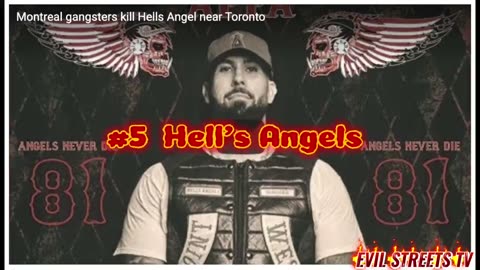
Don't get it twisted, I'm still coming through with them hood gangster tales, but I gotta switch it up for the algorithm, you feel me? Trying to pull different types of traffic and all that. So do me a solid, run that like button up, the next joint I'm dropping gonna take it right back to the block. When you hear the word Mafia, you already know what time it is, power moves, structure, and criminal dynasties that been running whole cities from the cut. From Sicily all the way to the States, Canada, and down to Mexico, these organizations don't just move silent, they move with pure terror. Law enforcement stay shook, governments can't shut 'em down, and most street gangs won't even think about testing them. But check it, not everybody folded though. Some gangs was bold enough, wild enough to step right up to the Mafia, bringing that pressure to organizations that don't usually get checked. These wasn't just any crews neither. These was the type of gangs that had even the coldest mobsters watching they back. From the grimy streets of New York, where young reckless crews like the Westies gave the Italian Mafia straight headaches, to international outfits that refused to bow down to them old school dons, these gangs didn't just make it through, they had the Mafia breaking a sweat. Here's 10 of the hardest, most fearless crews that stepped in the ring with organized crime's heaviest hitters and lived to talk about it. Number 10, the Guston Gang, Southeast's wildest jack boys. Back in the 1920s, when prohibition had the streets flooded with bootleg liquor and dirty bread, every gangster in America was trying to get a plate. But over in South Boston, the Guston Gang wasn't about cooking up moonshine or running speakeasies, nah. They was straight jack boys, running up on rival crews and hijacking they liquor shipments. If you was moving product through Southy, you better had eyes in the back of your dome, cause Frankie Wallace and his squad was coming for your neck. The Irish gang didn't discriminate when it came to who they was robbing neither, other Irish outfits, Italian crews, whoever had something worth taking caught it. That reckless hustle put them on a collision course with the wrong people though, the Italian mob wasn't about to let some Southy stick up kids mess with they paper. So they did what the Mafia do best, sent a message. Wallace and his right hand man Dodo Walsh got took out, and just like that, the Guston Gang lost its top dog. But even after Wallace got murked, the gang kept pushing, and that beef with the Italians ain't die down. The Guston Gang might not have lasted forever, but they left they mark as one of the few crews crazy enough to take on the rising Mafia and pay the price for it. Number 9, the White Hand Gang, the last stand of New York's Irish mob. Before the five families locked down New York's underworld, the city was a free for all, with every crew clawing for a piece of the pie. The Italians had they blackhand extortion rings, but they wasn't the only gangsters running these streets. The Irish had they own muscle, and nobody flexed harder than Denny Mean's White Hand Gang, a ruthless outfit that made it crystal clear they wasn't letting the Italians take over without a war. Mean ran the Brooklyn waterfront with an iron grip, but power in these streets is never permanent. In 1920, somebody made sure that Mean got gunned down in his own bed. That left William Wild Bill Lovett in charge, and if you thought Mean was cold, Lovett was straight up reckless. He had no problem beefing with both the Italians and rival Irish crews, throwing South Brooklyn into a war zone. But the streets don't let you run wild forever. In 1923, Wild Bill got got, beaten and shot to death, left to bleed out like any other gangster who thought he was untouchable. Then came Richard Peg Leg Lonergan, the last real shot the Irish had at holding down the docks. Lonergan wasn't just about keeping his turf, he went on the offensive, running up on heavyweights like Joe Adonis, Albert Anastasia, and Vincent Mangano, the same men who would later build the modern Mafia. Lonergan's boldest move? Rolling into Adonis's own social club like he owned the place, trying to punk the Italians in they own backyard. That turned out to be his last mistake. On Christmas night in 1925, Lonergan and his boys got set up and lit up in an ambush at the Adonis run Adonis social club. Just like that, the White Hand Gang was done. With no one left to carry the torch, the Irish lost they grip on the New York underworld, and the Mafia took over for good. Number 8, the Lanzetti Brothers, Philly's last wild bunch. Philadelphia's underworld was a battleground in the early 1900s, and if you wasn't playing for keeps, you wasn't playing at all. When Salvatore Don Toridu Sabella took control of the city's Mafia in 1911, he knew one thing for sure, Max Boo Boo Hoff and the rival bootlegging gangs wasn't just gonna step aside and let him take over. Philly was up for grabs, and Sabella was down to get his hands dirty to lock it down. By the mid 1920s, Sabella was cleaning house, making sure nobody in his own camp had thoughts of flipping the script on him. He had Leo Lanzetti, Vincent Cocozza, and Joseph Zanghi marked as traitors, and in 1925, Leo caught bullets as he walked out of a barbershop, a classic mob message straight to the head. Two years later, Cocozza and Zanghi got the same treatment, left leaking out in the streets. Sabella wasn't just protecting his throne, he was putting his whole crew on notice, cross him and you die. By 1933, Sabella had stepped down as boss but stayed close to the action as consigliere, that same year he got pinched for the murders of Cocozza and Zanghi. But in true Mafia fashion, he beat the case and walked out the same day. His protege John Avena was running things by then, but the surviving Lanzetti brothers wasn't done yet. They clapped back and Avena got dropped on the street corner, turning the Philly streets into an open war zone. Enter Joseph Bruno, the new Mafia boss who wasted no time signing Willie Lanzetti's death warrant. When Willie got took out, the Lanzetti Brothers reign came to a bloody end, and the last of them fled Philly for good. With that, the Mafia locked down the city, and the Lanzettis became just another gang that tried and failed to go toe to toe with La Cosa Nostra. Number 7, Celtic Club, Danny Green's war on the Cleveland Mafia. By the 1970s, Cleveland was a war zone, and the Celtic Club was right at the center of it. Led by the notorious Irish gangster Danny Green, this crew went toe to toe with the Cleveland Mafia, turning the city into a battlefield filled with bombings, beat downs, and bodies dropping left and right. Scott Bernstein called it nearly a decade long bloodbath, and he wasn't lying. This was one of the most violent feuds in American mob history. Green and his crew wasn't just fighting Italians, they was taking out anyone who stood in they way. Alex Shondor Birns, a Jewish mobster and numbers boss, was blown to pieces in a car bomb. Cleveland Mafia figure John Conte was beaten to death. Mob connected union enforcer Joe Kovach was shot down. Cleveland Mafia underboss Collogiero Leo Lips Moceri vanished without a trace. Frank Pircio was another car bomb victim, and aspiring Cleveland Mafia boss John Nardi got the same fate when his car exploded. And finally, Danny Green himself was took out in broad daylight by the very method he had used on so many others, a car bomb. But the Celtic Club wasn't just handing out smoke, they was catching it too. Green's right hand man Art Sniper Sneperger accidentally blew himself up while trying to plant a bomb. He personally gunned down Michael Big Mike Frato when Frato tried to break away from the crew. Hells Angel Enith Eagle Crinnick was blown to bits while setting up a car bomb for a rival. Green's enforcer Keith the Rat Rocco went out the same way, caught a bomb meant for somebody else. This war lasted nearly ten years straight, with Green keeping the Cleveland Mafia on they toes the whole time. Even though Green eventually caught that final bomb, he proved that an Irish crew with enough heart and enough firepower could shake up the Mafia's whole operation. Number 6, the Westies, Hell's Kitchen's last Irish stand. If you talking about gangs that made the Mafia nervous, you gotta talk about the Westies. New York's Hell's Kitchen neighborhood was they fortress, and these Irish cats didn't bow down to nobody. Led by Mickey Spillane and later James Jimmy Coonan, the Westies was wild, unpredictable, and straight up violent in a way that even the Mafia had to respect. The Italians controlled most of New York, but Hell's Kitchen? That was Westie territory, and they defended it like it was their own personal country. These cats would run up on anybody, rob anybody, and kill anybody if the price was right. The Mafia tried sending messages, but the Westies kept coming back harder. Jimmy Coonan took over in the late 1970s and turned the whole gang into a murder machine. They was working hits for everybody, doing jobs for the mob when they needed something dirty handled, but they never fully submitted to nobody. The Westies had their own code, their own rules, and they made money their way. That independence was what made 'em dangerous. Sure, some of 'em got bagged eventually, and yeah, Jimmy Coonan flipped and became a rat, but while the Westies was hot, they was one of the few crews the Mafia actually had to negotiate with instead of just taking out. That's power right there. Number 5, the Purple Gang, Detroit's Jewish bootleggers. Back in the Prohibition era, the Purple Gang was running Detroit like it was their own personal goldmine. These wasn't your typical street gang neither, these was organized, intelligent, ruthless Jewish gangsters who understood business better than most businessmen. Led by brothers Abe and Harry Fleisher, the Purple Gang controlled the bootlegging, the gambling, the numbers, everything coming through Motor City. When the Mafia tried to move in on their territory, the Purple Gang said nah, this is ours. They fought back hard, using superior intelligence and violence to keep the Italian mob at bay. The Purples was known for kidnapping, extortion, and straight up murder when it came to protecting their interests. They didn't play by Mafia rules because they had built their own empire before the Mafia even got organized. By the 1930s, federal heat and internal conflict started tearing the Purple Gang apart, but for a solid fifteen years, they was the undisputed rulers of Detroit and a real thorn in the Mafia's side. Number 4, the Dixie Mafia, the South's wild card. While everybody was talking about the five families and the Chicago outfit, the Dixie Mafia was building something different down South. These cats operated all through Mississippi, Louisiana, Arkansas, and Tennessee, running everything from bootlegging to stolen goods to murder for hire. The Dixie Mafia wasn't as structured as the traditional Mafia, but that's what made 'em dangerous. They was wild cards, unpredictable, and they didn't follow the old school rules. When the traditional Mafia tried to move in on Southern territory, they ran into the Dixie Mafia and realized quick that the South had its own criminal system. The Dixie Mafia took care of business their own way, and they wasn't about to let New York or Chicago tell 'em how to run things. These cats was involved in some of the most brutal crimes of the era, and they operated with almost no law enforcement interference because the South was too spread out and too independent. The Dixie Mafia proved that organized crime didn't have to look like the Italian Mafia to be effective and deadly. Number 3, the Medellin Cartel, when drug kingpins challenged the mob's reign. By the 1980s, everybody thought organized crime was about Italian guys in suits making power moves from social clubs. Then the Medellin Cartel came through and changed the whole game. Pablo Escobar and his crew didn't care about tradition or respect or the old ways. They was moving cocaine on a scale the Mafia never seen before, and they was making more money than the mob could even imagine. When the Mafia tried to protect their interests, the Cartel straight up bombed them. They brought a level of violence and disrespect that the traditional mob couldn't handle. The Cartel didn't do sit-downs or negotiations, they did bullets and bombs. They was moving product through the Mafia's own territories, and when the mob tried to stop 'em, the Cartel went to war. The Medellin Cartel represented a new type of criminal organization, one that was willing to bring more heat and more violence than anybody expected. Even though federal law enforcement eventually brought down Escobar and his crew, they proved that the Mafia's dominance wasn't permanent. A new breed of criminal was rising, and they didn't have respect for the old ways. Number 2, the Russian Mafia, when the cold war brought new competition. When the Soviet Union collapsed in the late 1980s, a whole new type of organized crime crew came pouring into the States. The Russian Mafia wasn't like nothing the American criminal underworld had ever seen before. These cats came from a military background, they was educated, they was organized, and they was willing to do things that even the Italian Mafia thought twice about. The Russians didn't just fight for territory, they literally went to war with established crime organizations. In Brighton Beach, Brooklyn, they straight up took over areas that the Mafia had controlled for decades. They brought weapons, tactics, and a level of violence that left the old mob confused and outgunned. The Russian Mafia wasn't interested in tradition or sitting down and making deals, they wanted to take over, and they had the firepower and the brains to do it. The Mafia realized quick that these new cats wasn't gonna play by Italian mob rules. This wasn't just a gang trying to muscle in on turf, this was a completely different criminal organization with completely different values. By the 1990s, the Russian Mafia had established themselves as a legitimate power in American organized crime, and they did it by challenging the Mafia directly and winning in a lot of those confrontations. Number 1, the Hells Angels Motorcycle Club, when bikers took on La Cosa Nostra. If you want to talk about a gang that straight up challenged the Mafia and lived to tell the story, you gotta talk about the Hells Angels. These ain't no street gang, these is organized criminals on motorcycles, and they got chapters all over the world. The Angels didn't start out as a Mafia competitor, but by the 1970s and 1980s, they was moving drugs, running rackets, and operating in territories that the mob considered theirs. When the Mafia tried to shut 'em down, the Angels fought back with the same violence and organization. The Angels had something the Mafia didn't expect, they had a global network, discipline, and a culture of loyalty that rivaled the mob itself. The Angels was willing to go to war with anybody, including the Italian Mafia, and they wasn't intimidated by Mafia power or Mafia history. The most famous conflict was up in Canada during the 1990s when the Angels basically took over the drug trade from the Montreal Mafia. It wasn't just a street fight neither, this was organized warfare with military precision. The Angels won that war, and by doing it, they proved that the Mafia wasn't untouchable. The Hells Angels showed the world that a new type of criminal organization could challenge the old order and come out on top.
Now here's the thing, fam, the legacy of these gangs and their battles with the Mafia tells us something real important about power, territory, and the evolution of organized crime in America. The Mafia built empires that lasted generations, but these crews that stepped up and challenged them forced the mob to evolve, to adapt, and to realize that their dominance wasn't guaranteed forever. From the Irish gangs that held the line in New York and Boston, to the Jewish bootleggers that controlled Detroit, to the motorcycle clubs and international cartels that took over in the modern era, each one of these organizations proved that courage, organization, and willingness to use violence could change the game. The Mafia's legacy is real, that structure and tradition built something powerful, but the legacy of these gangs is just