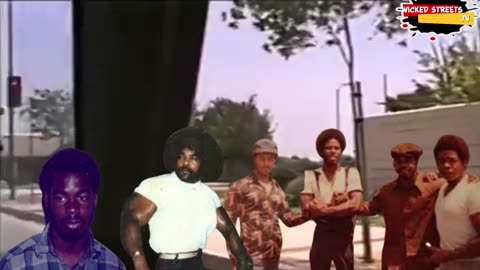
Y'all already know we back at it with another one, man. Big shout to all my day ones—members and subscribers—tapping in daily like clockwork. Y'all the backbone of this whole operation, the reason we still standing. Anybody looking to push they music, brand, or hustle, hit the inbox: evilstreetsmedia at gmail dot com. We can lock something in. And yo, salute to everybody sending them Cash App blessings—every dollar go right back into the channel. If you trying to support, that's evilstreetsTV on Cash App. Let's get it.
Aight, let's dive into this gangster chronicle. Before you can really grasp who the man behind the Crips was, you gotta understand the world that raised him. LA in the 50s and 60s was a straight-up war zone—shaped by civil rights battles and raw survival instincts. That's the lens Raymond Washington looked through. Social scientists say your surroundings mold most of your moves, and the rest? That's what you born with—your gifts, your instincts, how you handle heat. For Raymond, both nature and them unforgiving streets forged him into something dangerous: a commander, a fighter, a tactician, and eventually a myth in them ruthless blocks of South Central.
Raymond Lee Washington was born on a Friday—August 14th, 1953—in Los Angeles. His moms, Violet Samuel, had him at 23. He was her fourth kid. Came into this world at LA County General Hospital. Violet was a Texas girl, one of nine siblings who migrated to California chasing better days. She first touched down in Watts on Firth Boulevard before relocating to 76th Street between Wadsworth and Central. That's where Raymond came up with his three older brothers: Ronald Joe, Donnie Ray, and Reggie. His parents never married, and they split when he was young. Later, Violet married LV Barton in '64, but that only lasted four years. They had one kid together—Derard Barton—making him the youngest of the bunch.
When Violet first landed in LA, the city was still locked in segregation mode. Black folks were boxed out of the suburbs, shoved into packed, underserved hoods like Watts and Compton. Affordable, safe housing? That was a joke. People came to LA expecting opportunity but got hit with harsh reality. Jobs were vanishing fast, and resources were getting stripped from black neighborhoods. Back in the early 50s, white folks weren't just about keeping their blocks segregated—they were bombing homes, shooting up houses, burning crosses if a black family moved too close. Compton and Watts had once been thriving, but by the time Violet and thousands of others arrived, the rug had been yanked out from under them.
Imagine *The Grapes of Wrath*, but make it a black-only version. Except this wasn't no novel, no Pulitzer Prize-winning story. This was real life, and nobody was writing about it in a way that mattered. LA was a ticking time bomb, ready to blow. Steinbeck wrote about hungry men who had nothing left to fear—well, the same thing was brewing in Watts. But nobody in power saw it coming. Or if they did, they didn't care.
Violet's boys grew up like any kids in the hood—running blocks, hopping fences, playing street ball right in front of the house. They'd start their mornings walking over to 78th and McKinley, where the Black Panther Party ran a free breakfast program for the neighborhood. Kids whose parents couldn't always put food on the table. The Panthers' message of black pride and self-determination hit deep, shaping how these young boys saw the world.
Wild and full of energy, the Washington brothers stayed into it. Derard, the youngest, still laughs about how Raymond used to mess with him. One time, Raymond had his arm in a cast from a motorcycle accident, and Reggie had a cast too from slicing his tendons climbing a fence. Derard ran to the bathroom to snitch on Raymond for teasing him, and Reggie—fresh out the tub—told Raymond to chill. Raymond looked at him once, then swung that casted arm and knocked him right back into the tub.
Another time, Raymond was picking on Derard again. So the little bro grabbed a BB gun and shot him in the ass as he was climbing over a fence. "I was small, man. It was the only way I could defend myself," he said, cracking up. And like any young soldiers in the making, they had their own tests of toughness. One of their go-to games: standing toe-to-toe and taking turns throwing the hardest punch they could straight to the chest. No flinching, no tapping out. You either stood your ground or folded. That was the world Raymond Washington grew up in.
As teens and later as grown men, they all had their own talents. Reggie, the middle brother, had music in his blood. Dude could really play and had a gift for it. Three of the brothers ended up serving in the military, either during or after Vietnam. Donald Ray and Derard stepped up and volunteered for the Army, while Ronald Joe got drafted into the Marines. But back then, serving wasn't seen as some badge of honor like it is today. Nobody was stopping you on the street to say thank you for your service. Matter of fact, folks hated the military—spitting on soldiers when they came back home, calling them baby killers. Vietnam wasn't a war the people stood behind. Signing up meant you were pretty much guaranteed a one-way trip to a war zone. And when you got back—if you got back—you were met with nothing but side eyes and disrespect. Still, all three of them made that choice.
Reggie took a different route and got into construction with his fiancée's family. This wasn't no crew of hustlers or government check-chasers. They were solid, successful, and still are to this day.
So the little bro grabbed a BB gun and shot him in the ass as he was climbing over a fence. "I was small, man.
Raymond's mother looked back on Raymond as a happy kid, a natural athlete. But one thing he couldn't stand: going to the dentist. She laughed about that, but then got serious, recalling a day she left for work and came back to find the cops at her door again. They were there to take Raymond in, like they had before. "As a single mother, I felt like I was being singled out," she said. "I was out here working multiple jobs just trying to keep my family afloat in the hood and keep my boys out of trouble. But no matter what I did, trouble kept finding us." One of the officers told her, "Ma'am, you're not the only one. We're locking up a lot of kids these days." It wasn't much of a comfort. But at least she knew she wasn't the only mother watching helplessly as her son got hauled off in the back of a police car.
His youngest brother, Derard, put it plain and simple: "When Raymond was in juvie, he got noticed quick. He was a fighter. If he liked you, you were good—he'd look out for you, make sure nobody messed with you. But if he didn't? Man, he'd beat your ass. That was just how it was."
Raymond started out at 79th Street Elementary, then went on to Edison Jr. High and Charles Drew Jr. High. But as he got older, school got tougher—not just the books, but balancing that world with what he was learning in the streets. Out there, it was all about survival, while school was preaching some dream about a better future. But Raymond wasn't blind. He knew the deal. Nobody he knew had made it out clean from South Central. The streets were turning up, and he was watching it all unfold.
At just 12 years old, LA was already one of the wildest cities in the country, and it was about to get even crazier. The same week as Raymond's 12th birthday, the Watts riots jumped off—less than a mile from his crib. It all started with LAPD motor officer Lee Minikus pulling over Marquette Frye for drunk driving. Years later, Minikus told the LA Times that he didn't feel responsible for what went down, saying he was just doing his job. That was the mindset—cops saw everything in black and white, no in-between. Minikus claimed some dude in a pickup truck tipped him off about Frye driving drunk. He pulled Frye over, ran him through the usual sobriety tests, and decided he was under arrest. Frye wasn't even wilding at first—just joking for the growing crowd. But when his mom, Rena, pulled up and started going off on him, that energy shifted quick.
Frye's older brother Ronald was working nearby and came to the scene. When Ronald saw his little brother getting handled rough by the cops, he jumped in to help. But that only made it worse. LAPD brought backup—more officers rolling up, more aggression, more disrespect. They threw Ronald down, beat him down, arrested both brothers. Rena was screaming, crying, pleading with the officers to stop hurting her sons. But these cops didn't care. They had their orders, and black folks weren't supposed to talk back.
Word spread through Watts like wildfire. Frye brothers got manhandled. Police brutalizing our people again. By that night, crowds were gathering at the corner of 116th and Avalon. Young cats started throwing rocks, breaking windows, setting fires. By morning, it wasn't no protest anymore—it was all-out rebellion. Six days of burning, looting, and chaos. Thirty-four people dead, over a thousand arrested, property damage in the millions. The National Guard rolled in with tanks and machine guns, treating South Central like it was a war zone. Because to them, it was.
Raymond was only 12, but he was watching everything. Seeing his own people rise up. Seeing the power they had when they came together, even if it was raw and violent. Seeing the military occupation of his neighborhood. Seeing cops and guardsmen treating black folks like enemies. That imprint never left him.
After Watts, things in South Central changed. The rebellion had shown what could happen when people got fed up, but it also brought more police presence, more gang activity, more desperation. By the late 60s, the neighborhood was fractured into different sets and crews. You had the Slauson gang running things, the Gladiators, the Businessmen—all these different groups claiming territory, making rules, establishing hierarchies. It was chaos, but it was also opportunity for someone smart and ruthless enough to see the bigger picture.
Raymond was getting taller, stronger, meaner. He was running with crews, getting into serious fights, spending time in juvenile detention. Each time he went in, he came out harder, smarter, more connected. He was learning the game from every angle—from the old heads, from the other young soldiers, from his own tactical mind. He studied how power worked on the streets. Who had it, how they kept it, how they lost it.
By the early 1970s, Raymond Washington had established himself as one of the most dangerous young cats in South Central. He was fearless, calculating, and had the respect of older gang leaders who recognized his potential. Unlike the existing gangs that were mainly territorial and reactionary, Raymond was thinking bigger. He was talking about organization, about unity between different neighborhood sets, about building something that could challenge power at a scale nobody had seen before.
In 1969, Raymond made a move that would change everything. He decided to band together different gangs from South Central under one banner—the Crips. The name came from the canes that gang members used as walking sticks and weapons, but it also stood for something deeper: a unified force that could protect the neighborhood and establish control on their own terms. It wasn't no random gang—it was a calculated strategy to consolidate power and resources.
The original Crips started with just a few neighborhood sets coming together, but Raymond's vision was radical. He wasn't trying to be a neighborhood kingpin; he was trying to create a national organization. He recruited, mentored, and established rules and hierarchy. He created codes of conduct, territories, and an organizational structure that mimicked legitimate business operations. For someone with no formal education beyond high school, Raymond Washington had an intuitive understanding of organizational dynamics that would put most MBA programs to shame.
But success on the streets comes with a price. As the Crips grew more powerful throughout the early 1970s, they caught the attention of every rival gang, every police department, and every community leader. Raymond's own success became a target on his back. He knew people who wanted him dead—competitors, law enforcement, folks he'd wronged along the way.
On August 9, 1979, Raymond Washington, the architect of the Crips empire, was gunned down in South Central LA. He was only 25 years old. Shot multiple times in what everybody knew was a hit, but nobody would ever officially solve. Some say it was the Pirus coming for him in retaliation for Crips expansion. Others say it was internal—somebody hungry for power, looking to take over. The truth died with Raymond.
When Raymond went down, the Crips didn't collapse. They fractured, split into different factions, some of them turning on each other. But the organizational structure he built, the principles he established—those lived on. The gang continued to grow, adapt, and eventually became one of the most significant criminal organizations in American history, spreading from South Central to cities across the nation.
Raymond Washington's legacy is complicated as hell. He's revered by some as a visionary who tried to organize and protect his community. He's condemned by others as the architect of one of America's most destructive gang empires. The truth is somewhere in the middle. He was a product of his time—born into segregation, shaped by the Watts riots, channeling the energy and desperation of his neighborhood into something tangible, even if that something caused tremendous harm.
What's undeniable is that Raymond Washington changed the trajectory of gang culture in America forever. He proved that these organizations could be scaled, could be structured, could be something more than just neighborhood crews fighting over blocks. Whether you see him as a revolutionary figure or a criminal mastermind, his impact is undeniable. From the streets of South Central to every major city in this country, the Crips organization he created remains one of the most powerful and destructive forces ever to emerge from America's inner cities. Raymond Washington died young, but his name and legacy live eternal in the streets. That's the realest truth there is.